12 pages. Read it here, or download the PDF to keep, print or share. On a phone, pinch to zoom in on a page.
W H I T E P A P E R · O C T O B E R 2 0 2 6
The Canada Sovereign
Equity Endowment Fund
A permanent national stake in the economy
Canada makes possible — and a demand for a
formal federal review.
Canada taxes the flow of its economy and owns none of its stock. Every
G7 government runs a deficit, and every one reaches back into the
same operating economy to close it. This paper sets out a narrow
mechanism that builds a permanent public endowment from new
non-voting shares — with no cash taken from anyone — tests it against
six years of real corporate data, confronts every serious objection, and
asks Parliament to examine it properly.
T H E O W N E R S H I P A R G U M E N T
C A N A D A S O V E R E I G N F U N D . C O M
Page 1 of 12
S U M M A R Y
The argument in one page
Ottawa finances itself almost entirely from the operating economy: wages, purchases and corporate
profits, taxed once, in cash. It holds no claim at all on the far larger pool of wealth those profits
create once they are capitalized in Canadian equity markets. That gap is structural, and deficits are
its symptom.
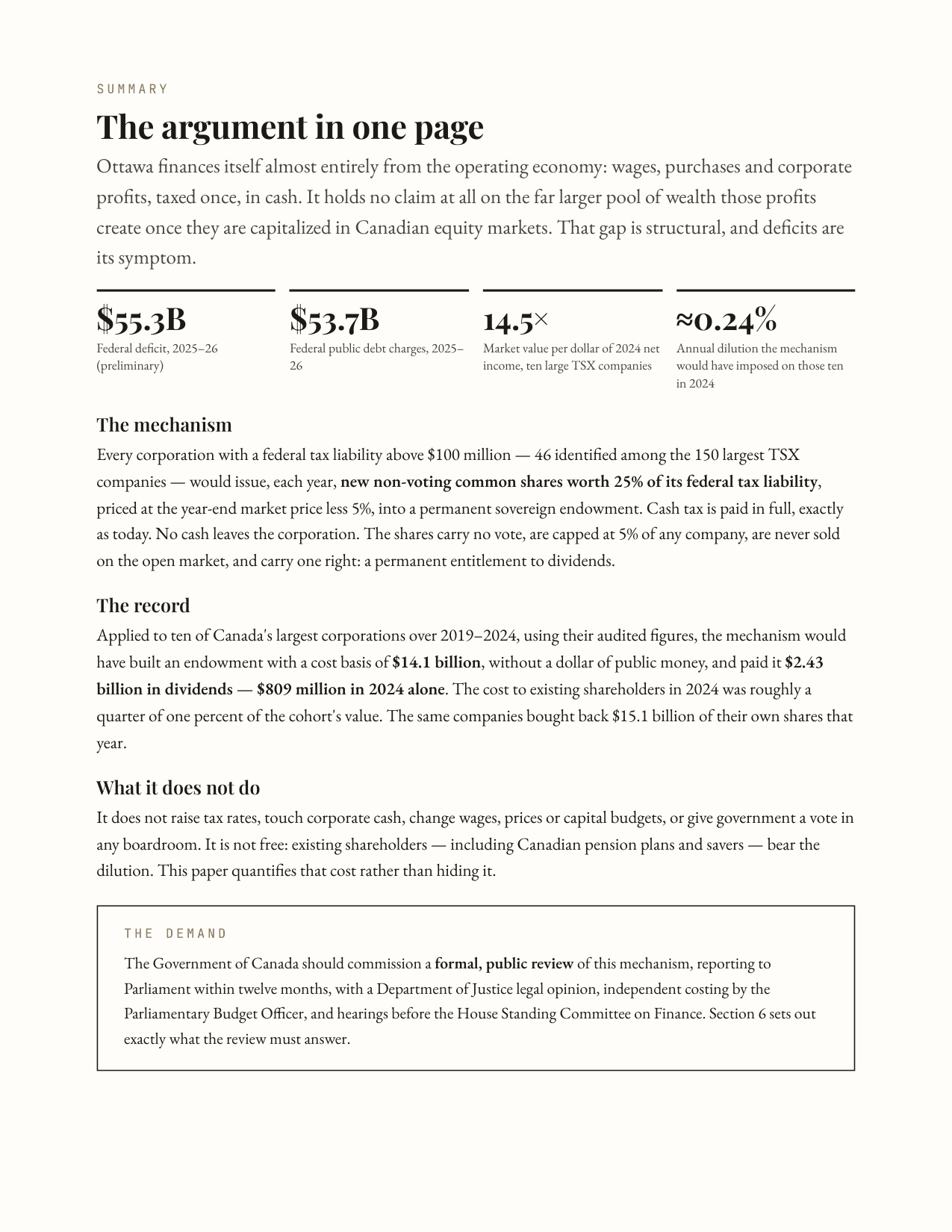
$55.3B
Federal deficit, 2025–26
(preliminary)
$53.7B
Federal public debt charges, 2025–
26
14.5×
Market value per dollar of 2024 net
income, ten large TSX companies
≈0.24%
Annual dilution the mechanism
would have imposed on those ten
in 2024
The mechanism
Every corporation with a federal tax liability above $100 million — 46 identified among the 150 largest TSX
companies — would issue, each year, new non-voting common shares worth 25% of its federal tax liability,
priced at the year-end market price less 5%, into a permanent sovereign endowment. Cash tax is paid in full, exactly
as today. No cash leaves the corporation. The shares carry no vote, are capped at 5% of any company, are never sold
on the open market, and carry one right: a permanent entitlement to dividends.
The record
Applied to ten of Canada's largest corporations over 2019–2024, using their audited figures, the mechanism would
have built an endowment with a cost basis of $14.1 billion, without a dollar of public money, and paid it $2.43
billion in dividends — $809 million in 2024 alone. The cost to existing shareholders in 2024 was roughly a
quarter of one percent of the cohort's value. The same companies bought back $15.1 billion of their own shares that
year.
What it does not do
It does not raise tax rates, touch corporate cash, change wages, prices or capital budgets, or give government a vote in
any boardroom. It is not free: existing shareholders — including Canadian pension plans and savers — bear the
dilution. This paper quantifies that cost rather than hiding it.
T H E D E M A N D
The Government of Canada should commission a formal, public review of this mechanism, reporting to
Parliament within twelve months, with a Department of Justice legal opinion, independent costing by the
Parliamentary Budget Officer, and hearings before the House Standing Committee on Finance. Section 6 sets out
exactly what the review must answer.
Page 2 of 12
1 · T H E P R O B L E M
A one-dollar world
Every wage in Canada is paid from the operating economy. So is every income tax, every sales tax
and every corporate tax. When a government runs short, it is the only place it knows to reach.
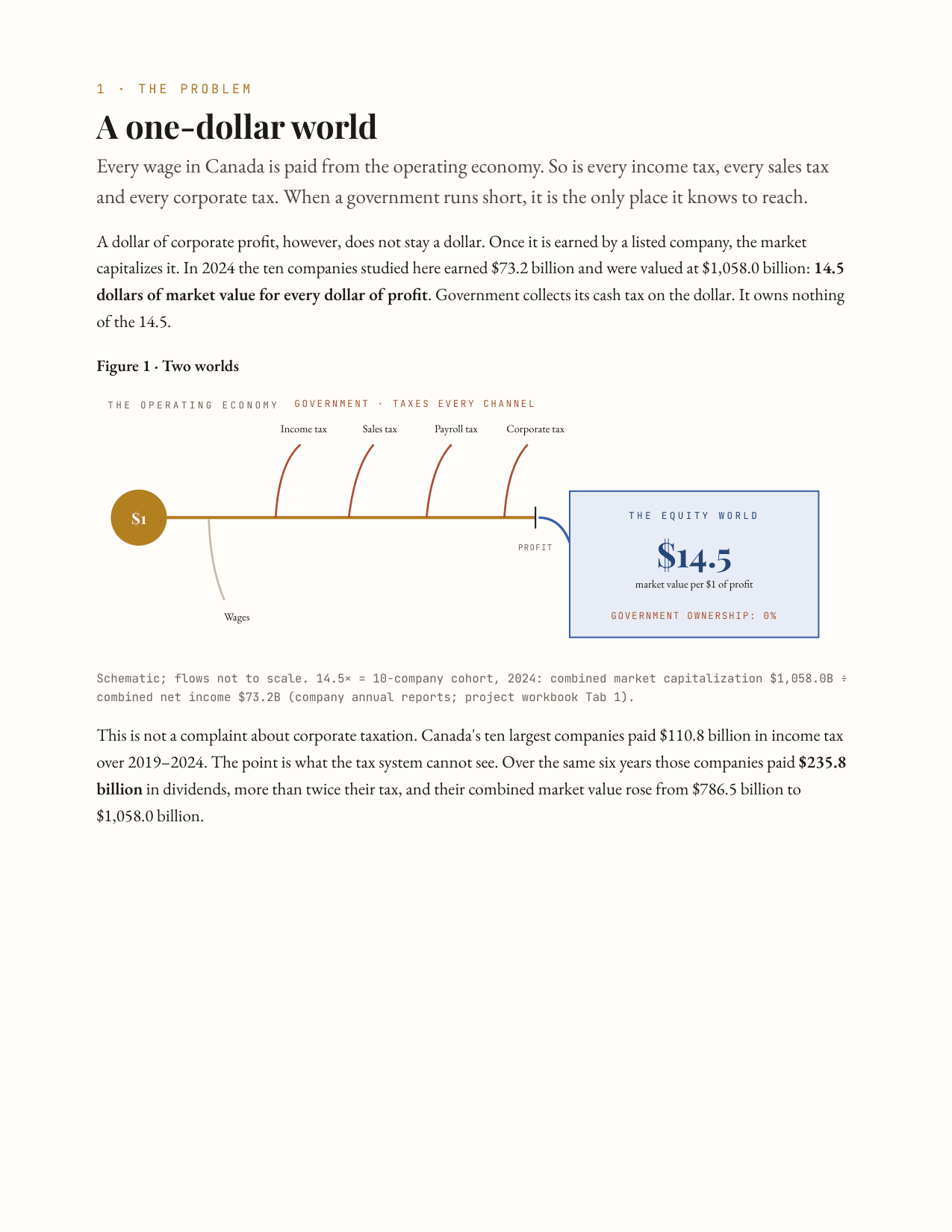
A dollar of corporate profit, however, does not stay a dollar. Once it is earned by a listed company, the market
capitalizes it. In 2024 the ten companies studied here earned $73.2 billion and were valued at $1,058.0 billion: 14.5
dollars of market value for every dollar of profit. Government collects its cash tax on the dollar. It owns nothing
of the 14.5.
Figure 1 · Two worlds
T H E O P E R A T I N G E C O N O M Y
G O V E R N M E N T · T A X E S E V E R Y C H A N N E L
$1
Income tax
Sales tax
Payroll tax
Corporate tax
Wages
PROFIT
T H E E Q U I T Y W O R L D
$14.5
market value per $1 of profit
GOVERNMENT OWNERSHIP: 0%
Schematic; flows not to scale. 14.5× = 10-company cohort, 2024: combined market capitalization $1,058.0B ÷
combined net income $73.2B (company annual reports; project workbook Tab 1).
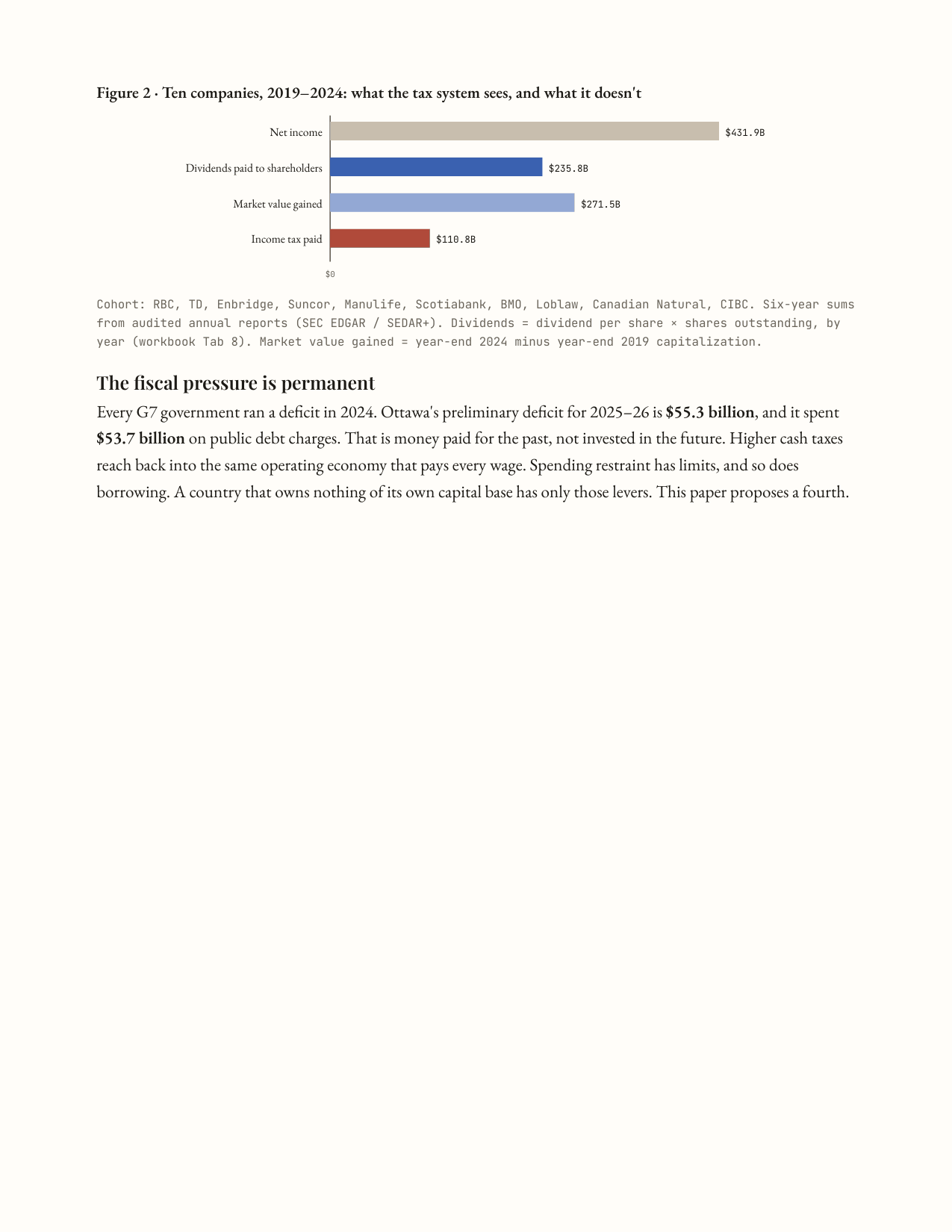
This is not a complaint about corporate taxation. Canada's ten largest companies paid $110.8 billion in income tax
over 2019–2024. The point is what the tax system cannot see. Over the same six years those companies paid $235.8
billion in dividends, more than twice their tax, and their combined market value rose from $786.5 billion to
$1,058.0 billion.
Page 3 of 12
Figure 2 · Ten companies, 2019–2024: what the tax system sees, and what it doesn't
Net income
$431.9B
Dividends paid to shareholders
$235.8B
Market value gained
$271.5B
Income tax paid
$110.8B
$0
Cohort: RBC, TD, Enbridge, Suncor, Manulife, Scotiabank, BMO, Loblaw, Canadian Natural, CIBC. Six-year sums
from audited annual reports (SEC EDGAR / SEDAR+). Dividends = dividend per share × shares outstanding, by
year (workbook Tab 8). Market value gained = year-end 2024 minus year-end 2019 capitalization.
The fiscal pressure is permanent
Every G7 government ran a deficit in 2024. Ottawa's preliminary deficit for 2025–26 is $55.3 billion, and it spent
$53.7 billion on public debt charges. That is money paid for the past, not invested in the future. Higher cash taxes
reach back into the same operating economy that pays every wage. Spending restraint has limits, and so does
borrowing. A country that owns nothing of its own capital base has only those levers. This paper proposes a fourth.
Page 4 of 12
2 · T H E M E C H A N I S M
One formula, fixed in statute
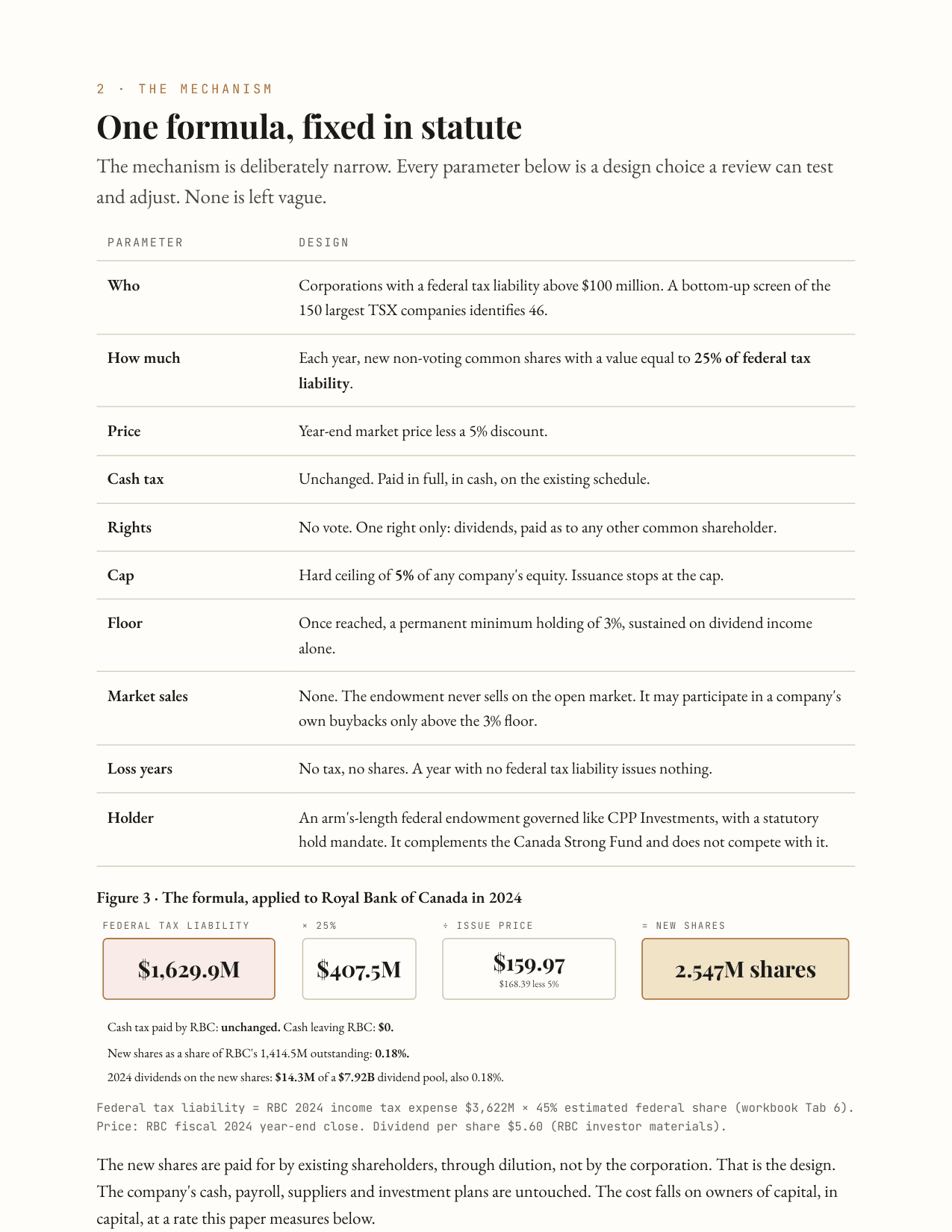
The mechanism is deliberately narrow. Every parameter below is a design choice a review can test
and adjust. None is left vague.
PARAMETER
DESIGN
Who
Corporations with a federal tax liability above $100 million. A bottom-up screen of the
150 largest TSX companies identifies 46.
How much
Each year, new non-voting common shares with a value equal to 25% of federal tax
liability.
Price
Year-end market price less a 5% discount.
Cash tax
Unchanged. Paid in full, in cash, on the existing schedule.
Rights
No vote. One right only: dividends, paid as to any other common shareholder.
Cap
Hard ceiling of 5% of any company's equity. Issuance stops at the cap.
Floor
Once reached, a permanent minimum holding of 3%, sustained on dividend income
alone.
Market sales
None. The endowment never sells on the open market. It may participate in a company's
own buybacks only above the 3% floor.
Loss years
No tax, no shares. A year with no federal tax liability issues nothing.
Holder
An arm's-length federal endowment governed like CPP Investments, with a statutory
hold mandate. It complements the Canada Strong Fund and does not compete with it.
Figure 3 · The formula, applied to Royal Bank of Canada in 2024
FEDERAL TAX LIABILITY
$1,629.9M
× 25%
$407.5M
÷ ISSUE PRICE
$159.97
$168.39 less 5%
= NEW SHARES
2.547M shares
Cash tax paid by RBC: unchanged. Cash leaving RBC: $0.
New shares as a share of RBC's 1,414.5M outstanding: 0.18%.
2024 dividends on the new shares: $14.3M of a $7.92B dividend pool, also 0.18%.
Federal tax liability = RBC 2024 income tax expense $3,622M × 45% estimated federal share (workbook Tab 6).
Price: RBC fiscal 2024 year-end close. Dividend per share $5.60 (RBC investor materials).
The new shares are paid for by existing shareholders, through dilution, not by the corporation. That is the design.
The company's cash, payroll, suppliers and investment plans are untouched. The cost falls on owners of capital, in
capital, at a rate this paper measures below.
Page 5 of 12
3 · T H E R E C O R D
Six years of real data, ten real companies
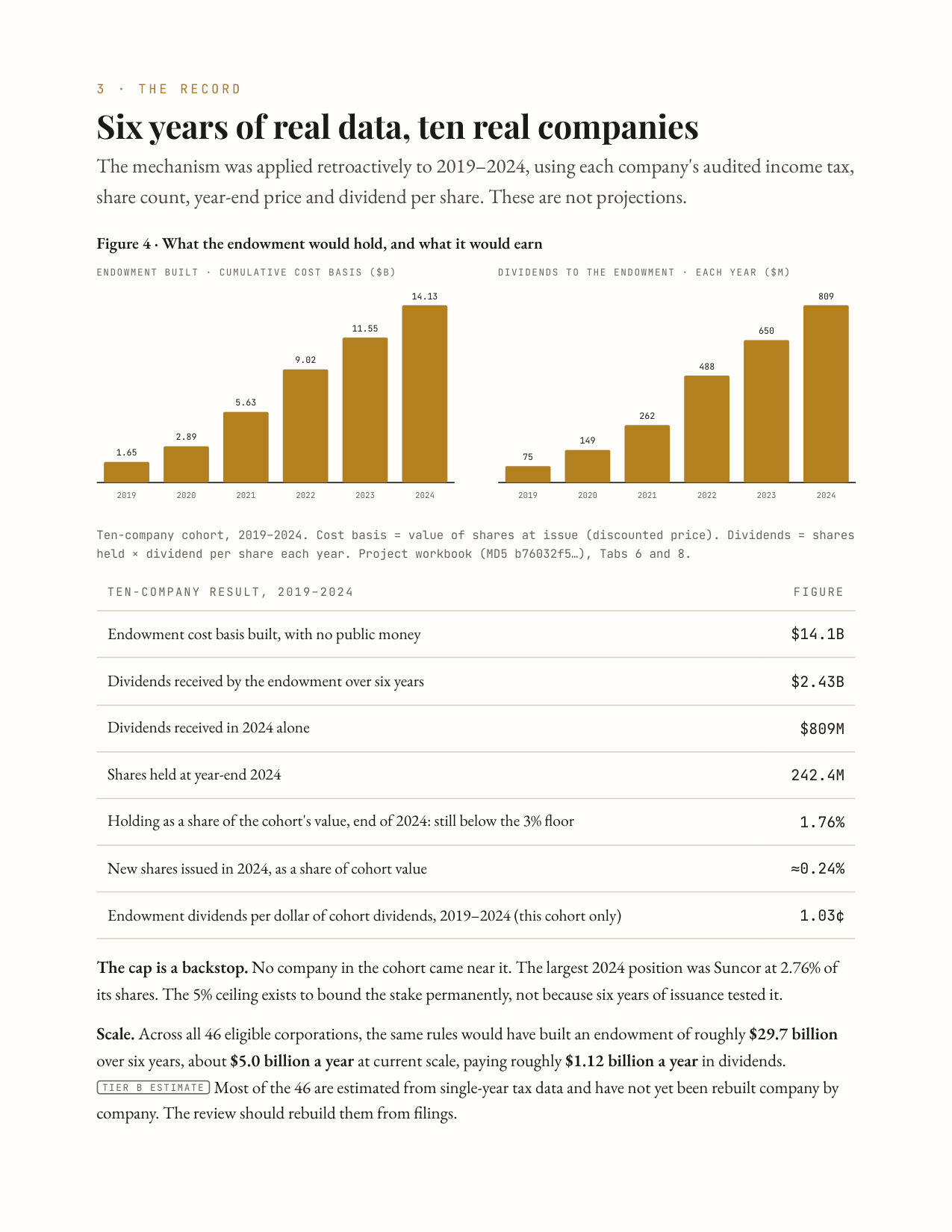
The mechanism was applied retroactively to 2019–2024, using each company's audited income tax,
share count, year-end price and dividend per share. These are not projections.
Figure 4 · What the endowment would hold, and what it would earn
ENDOWMENT BUILT · CUMULATIVE COST BASIS ($B)
1.65
2019
2.89
2020
5.63
2021
9.02
2022
11.55
2023
14.13
2024
DIVIDENDS TO THE ENDOWMENT · EACH YEAR ($M)
75
2019
149
2020
262
2021
488
2022
650
2023
809
2024
Ten-company cohort, 2019–2024. Cost basis = value of shares at issue (discounted price). Dividends = shares
held × dividend per share each year. Project workbook (MD5 b76032f5…), Tabs 6 and 8.
TEN-COMPANY RESULT, 2019–2024
FIGURE
Endowment cost basis built, with no public money
$14.1B
Dividends received by the endowment over six years
$2.43B
Dividends received in 2024 alone
$809M
Shares held at year-end 2024
242.4M
Holding as a share of the cohort's value, end of 2024: still below the 3% floor
1.76%
New shares issued in 2024, as a share of cohort value
≈0.24%
Endowment dividends per dollar of cohort dividends, 2019–2024 (this cohort only)
1.03¢
The cap is a backstop. No company in the cohort came near it. The largest 2024 position was Suncor at 2.76% of
its shares. The 5% ceiling exists to bound the stake permanently, not because six years of issuance tested it.
Scale. Across all 46 eligible corporations, the same rules would have built an endowment of roughly $29.7 billion
over six years, about $5.0 billion a year at current scale, paying roughly $1.12 billion a year in dividends.
TIER B ESTIMATE Most of the 46 are estimated from single-year tax data and have not yet been rebuilt company by
company. The review should rebuild them from filings.
Page 6 of 12
4 · W H O P A Y S
The cost is real, small, and borne in capital
The mechanism is not free, and this paper will not pretend otherwise. Each new share dilutes every
existing one. In 2024 the dilution across the ten companies was about a quarter of one percent.
Measured either way the answer is the same. The shares issued in 2024 were 0.244% of the cohort's market value,
and their dividends would have been 0.259% of the $46.8 billion the cohort paid out. By company, the range ran
from 0.54% (Suncor) down to 0.18% (RBC and Enbridge).
Those who bear it are existing shareholders: Canadian pension plans, RRSP and TFSA savers, mutual and index
funds, and foreign investors. Canadians are among those diluted. The review must measure precisely how much of
the burden falls on domestic retirement savings and how much on foreign holders.
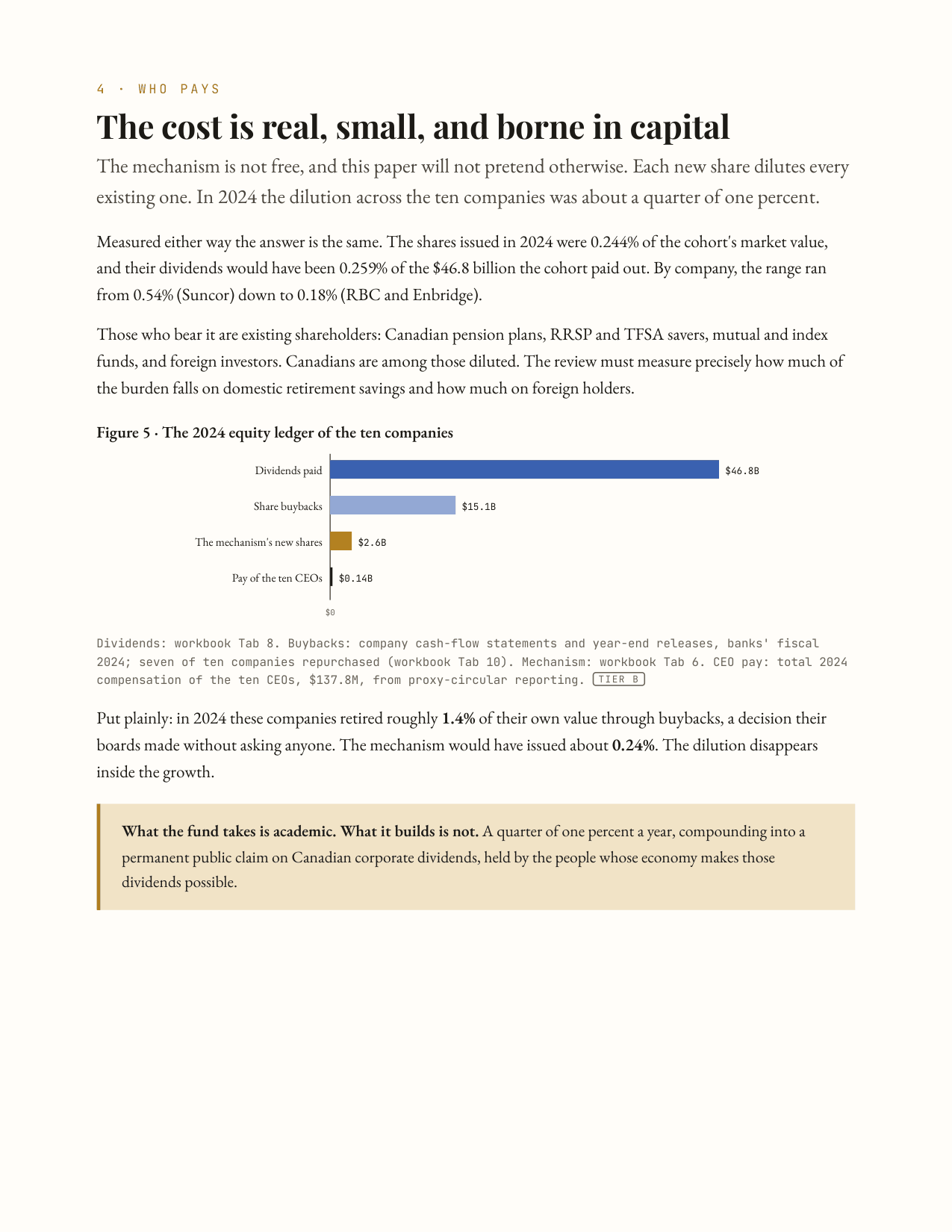
Figure 5 · The 2024 equity ledger of the ten companies
Dividends paid
$46.8B
Share buybacks
$15.1B
The mechanism's new shares
$2.6B
Pay of the ten CEOs
$0.14B
$0
Dividends: workbook Tab 8. Buybacks: company cash-flow statements and year-end releases, banks' fiscal
2024; seven of ten companies repurchased (workbook Tab 10). Mechanism: workbook Tab 6. CEO pay: total 2024
compensation of the ten CEOs, $137.8M, from proxy-circular reporting. TIER B
Put plainly: in 2024 these companies retired roughly 1.4% of their own value through buybacks, a decision their
boards made without asking anyone. The mechanism would have issued about 0.24%. The dilution disappears
inside the growth.
What the fund takes is academic. What it builds is not. A quarter of one percent a year, compounding into a
permanent public claim on Canadian corporate dividends, held by the people whose economy makes those
dividends possible.
Page 7 of 12
5 · O B S T A C L E S A N D O B J E C T I O N S
Every hard question, answered or assigned
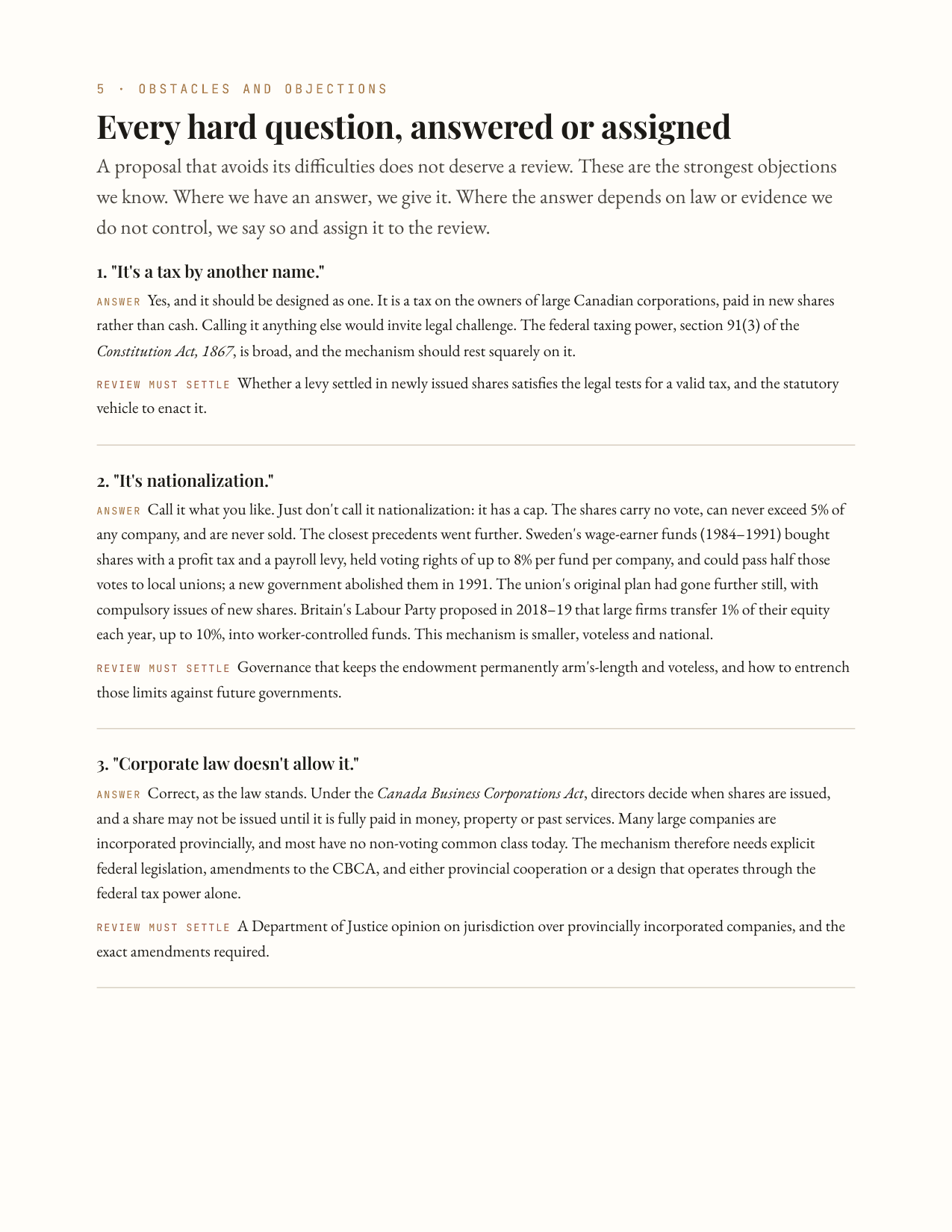
A proposal that avoids its difficulties does not deserve a review. These are the strongest objections
we know. Where we have an answer, we give it. Where the answer depends on law or evidence we
do not control, we say so and assign it to the review.
1. "It's a tax by another name."
ANSWER Yes, and it should be designed as one. It is a tax on the owners of large Canadian corporations, paid in new shares
rather than cash. Calling it anything else would invite legal challenge. The federal taxing power, section 91(3) of the
Constitution Act, 1867, is broad, and the mechanism should rest squarely on it.
REVIEW MUST SETTLE Whether a levy settled in newly issued shares satisfies the legal tests for a valid tax, and the statutory
vehicle to enact it.
2. "It's nationalization."
ANSWER Call it what you like. Just don't call it nationalization: it has a cap. The shares carry no vote, can never exceed 5% of
any company, and are never sold. The closest precedents went further. Sweden's wage-earner funds (1984–1991) bought
shares with a profit tax and a payroll levy, held voting rights of up to 8% per fund per company, and could pass half those
votes to local unions; a new government abolished them in 1991. The union's original plan had gone further still, with
compulsory issues of new shares. Britain's Labour Party proposed in 2018–19 that large firms transfer 1% of their equity
each year, up to 10%, into worker-controlled funds. This mechanism is smaller, voteless and national.
REVIEW MUST SETTLE Governance that keeps the endowment permanently arm's-length and voteless, and how to entrench
those limits against future governments.
3. "Corporate law doesn't allow it."
ANSWER Correct, as the law stands. Under the Canada Business Corporations Act, directors decide when shares are issued,
and a share may not be issued until it is fully paid in money, property or past services. Many large companies are
incorporated provincially, and most have no non-voting common class today. The mechanism therefore needs explicit
federal legislation, amendments to the CBCA, and either provincial cooperation or a design that operates through the
federal tax power alone.
REVIEW MUST SETTLE A Department of Justice opinion on jurisdiction over provincially incorporated companies, and the
exact amendments required.
Page 8 of 12
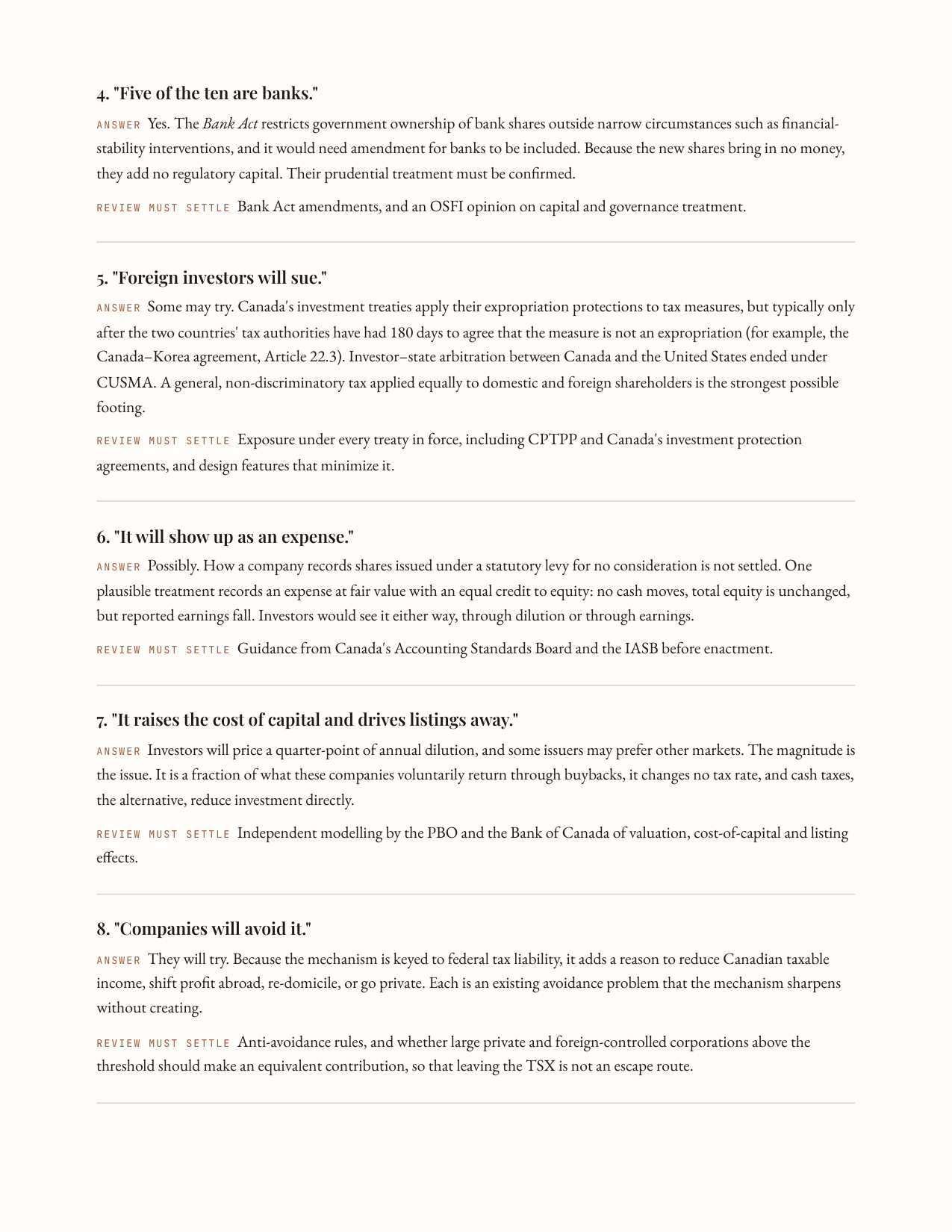
4. "Five of the ten are banks."
ANSWER Yes. The Bank Act restricts government ownership of bank shares outside narrow circumstances such as financial-
stability interventions, and it would need amendment for banks to be included. Because the new shares bring in no money,
they add no regulatory capital. Their prudential treatment must be confirmed.
REVIEW MUST SETTLE Bank Act amendments, and an OSFI opinion on capital and governance treatment.
5. "Foreign investors will sue."
ANSWER Some may try. Canada's investment treaties apply their expropriation protections to tax measures, but typically only
after the two countries' tax authorities have had 180 days to agree that the measure is not an expropriation (for example, the
Canada–Korea agreement, Article 22.3). Investor–state arbitration between Canada and the United States ended under
CUSMA. A general, non-discriminatory tax applied equally to domestic and foreign shareholders is the strongest possible
footing.
REVIEW MUST SETTLE Exposure under every treaty in force, including CPTPP and Canada's investment protection
agreements, and design features that minimize it.
6. "It will show up as an expense."
ANSWER Possibly. How a company records shares issued under a statutory levy for no consideration is not settled. One
plausible treatment records an expense at fair value with an equal credit to equity: no cash moves, total equity is unchanged,
but reported earnings fall. Investors would see it either way, through dilution or through earnings.
REVIEW MUST SETTLE Guidance from Canada's Accounting Standards Board and the IASB before enactment.
7. "It raises the cost of capital and drives listings away."
ANSWER Investors will price a quarter-point of annual dilution, and some issuers may prefer other markets. The magnitude is
the issue. It is a fraction of what these companies voluntarily return through buybacks, it changes no tax rate, and cash taxes,
the alternative, reduce investment directly.
REVIEW MUST SETTLE Independent modelling by the PBO and the Bank of Canada of valuation, cost-of-capital and listing
effects.
8. "Companies will avoid it."
ANSWER They will try. Because the mechanism is keyed to federal tax liability, it adds a reason to reduce Canadian taxable
income, shift profit abroad, re-domicile, or go private. Each is an existing avoidance problem that the mechanism sharpens
without creating.
REVIEW MUST SETTLE Anti-avoidance rules, and whether large private and foreign-controlled corporations above the
threshold should make an equivalent contribution, so that leaving the TSX is not an escape route.
Page 9 of 12
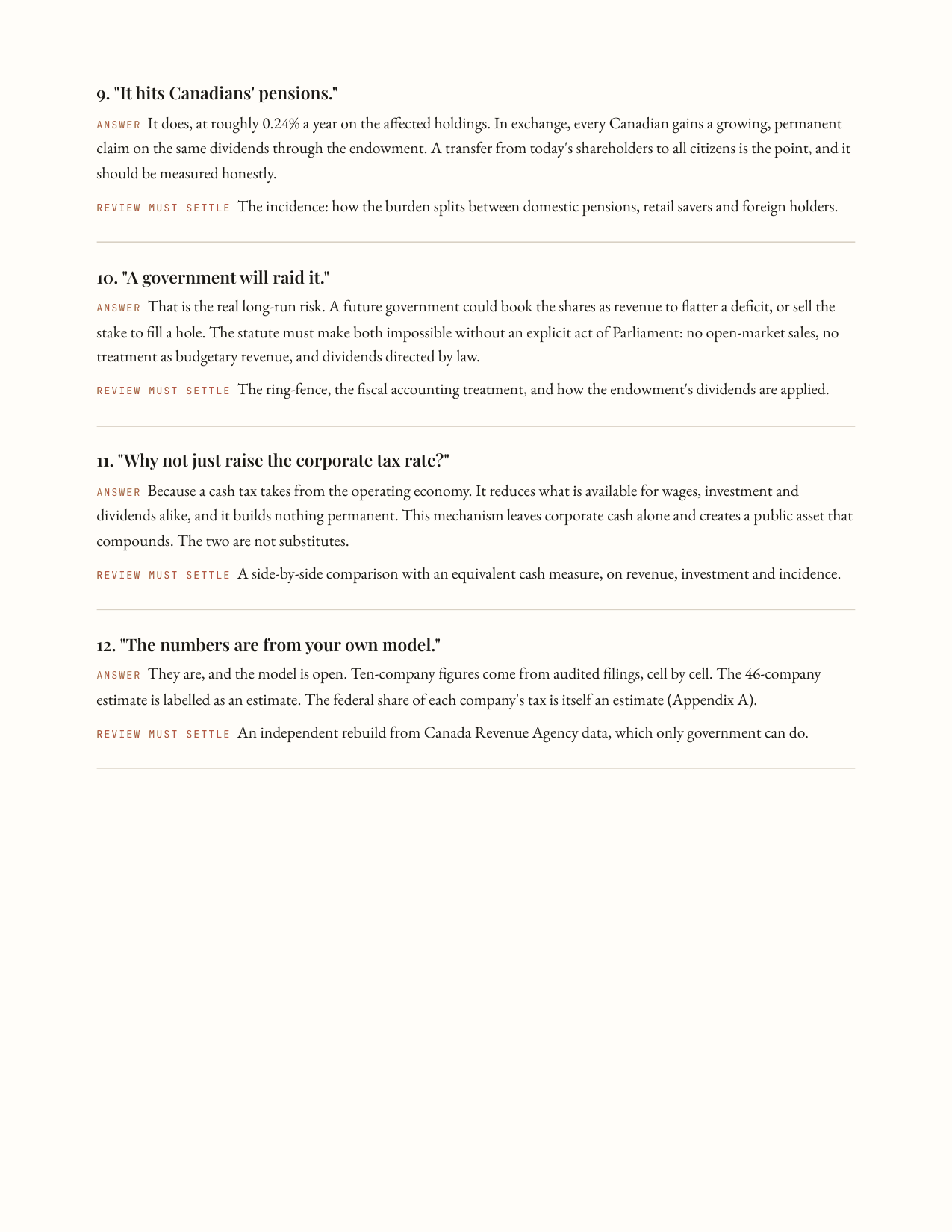
9. "It hits Canadians' pensions."
ANSWER It does, at roughly 0.24% a year on the affected holdings. In exchange, every Canadian gains a growing, permanent
claim on the same dividends through the endowment. A transfer from today's shareholders to all citizens is the point, and it
should be measured honestly.
REVIEW MUST SETTLE The incidence: how the burden splits between domestic pensions, retail savers and foreign holders.
10. "A government will raid it."
ANSWER That is the real long-run risk. A future government could book the shares as revenue to flatter a deficit, or sell the
stake to fill a hole. The statute must make both impossible without an explicit act of Parliament: no open-market sales, no
treatment as budgetary revenue, and dividends directed by law.
REVIEW MUST SETTLE The ring-fence, the fiscal accounting treatment, and how the endowment's dividends are applied.
11. "Why not just raise the corporate tax rate?"
ANSWER Because a cash tax takes from the operating economy. It reduces what is available for wages, investment and
dividends alike, and it builds nothing permanent. This mechanism leaves corporate cash alone and creates a public asset that
compounds. The two are not substitutes.
REVIEW MUST SETTLE A side-by-side comparison with an equivalent cash measure, on revenue, investment and incidence.
12. "The numbers are from your own model."
ANSWER They are, and the model is open. Ten-company figures come from audited filings, cell by cell. The 46-company
estimate is labelled as an estimate. The federal share of each company's tax is itself an estimate (Appendix A).
REVIEW MUST SETTLE An independent rebuild from Canada Revenue Agency data, which only government can do.
Page 10 of 12
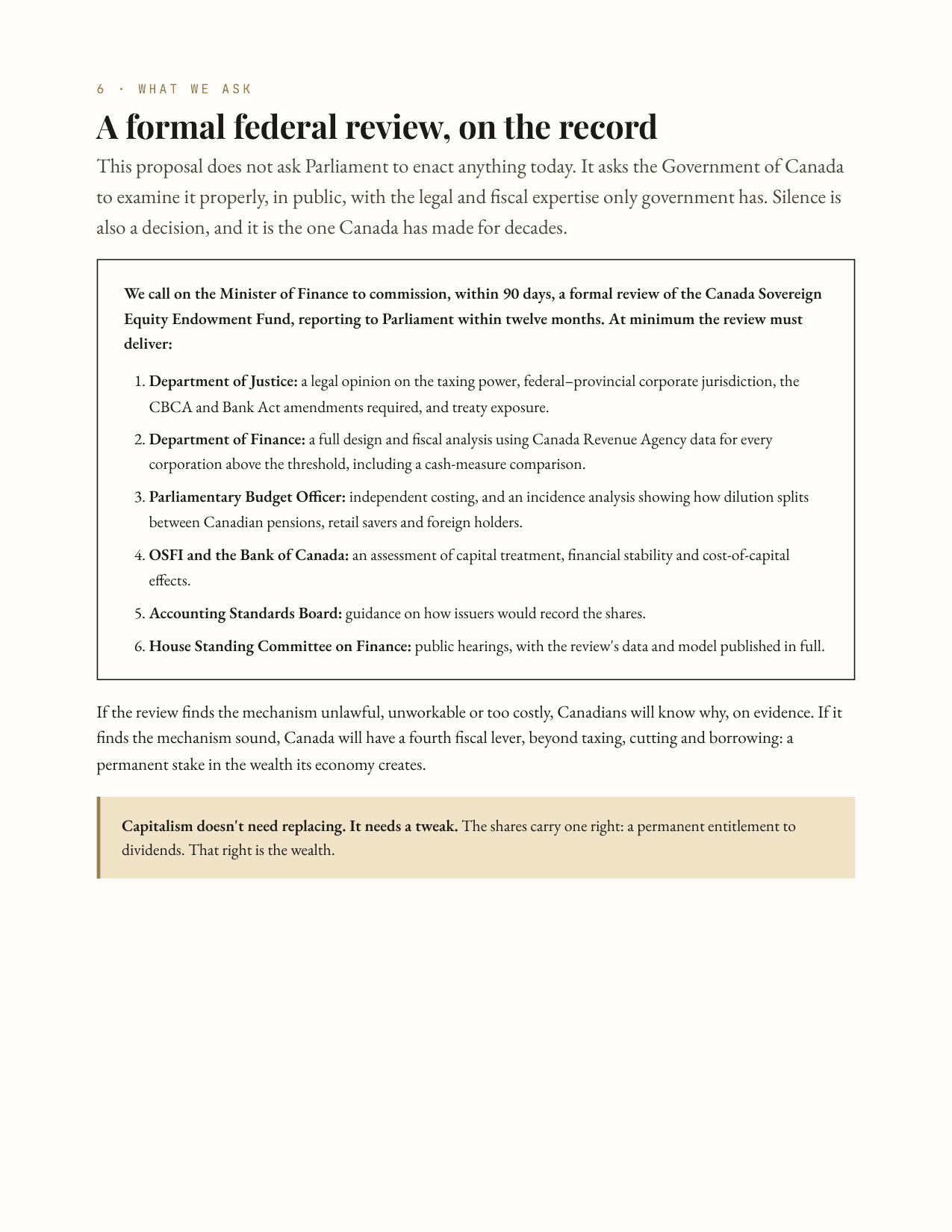
6 · W H A T W E A S K
A formal federal review, on the record
This proposal does not ask Parliament to enact anything today. It asks the Government of Canada
to examine it properly, in public, with the legal and fiscal expertise only government has. Silence is
also a decision, and it is the one Canada has made for decades.
We call on the Minister of Finance to commission, within 90 days, a formal review of the Canada Sovereign
Equity Endowment Fund, reporting to Parliament within twelve months. At minimum the review must
deliver:
1. Department of Justice: a legal opinion on the taxing power, federal–provincial corporate jurisdiction, the
CBCA and Bank Act amendments required, and treaty exposure.
2. Department of Finance: a full design and fiscal analysis using Canada Revenue Agency data for every
corporation above the threshold, including a cash-measure comparison.
3. Parliamentary Budget Officer: independent costing, and an incidence analysis showing how dilution splits
between Canadian pensions, retail savers and foreign holders.
4. OSFI and the Bank of Canada: an assessment of capital treatment, financial stability and cost-of-capital
effects.
5. Accounting Standards Board: guidance on how issuers would record the shares.
6. House Standing Committee on Finance: public hearings, with the review's data and model published in full.
If the review finds the mechanism unlawful, unworkable or too costly, Canadians will know why, on evidence. If it
finds the mechanism sound, Canada will have a fourth fiscal lever, beyond taxing, cutting and borrowing: a
permanent stake in the wealth its economy creates.
Capitalism doesn't need replacing. It needs a tweak. The shares carry one right: a permanent entitlement to
dividends. That right is the wealth.
Page 11 of 12
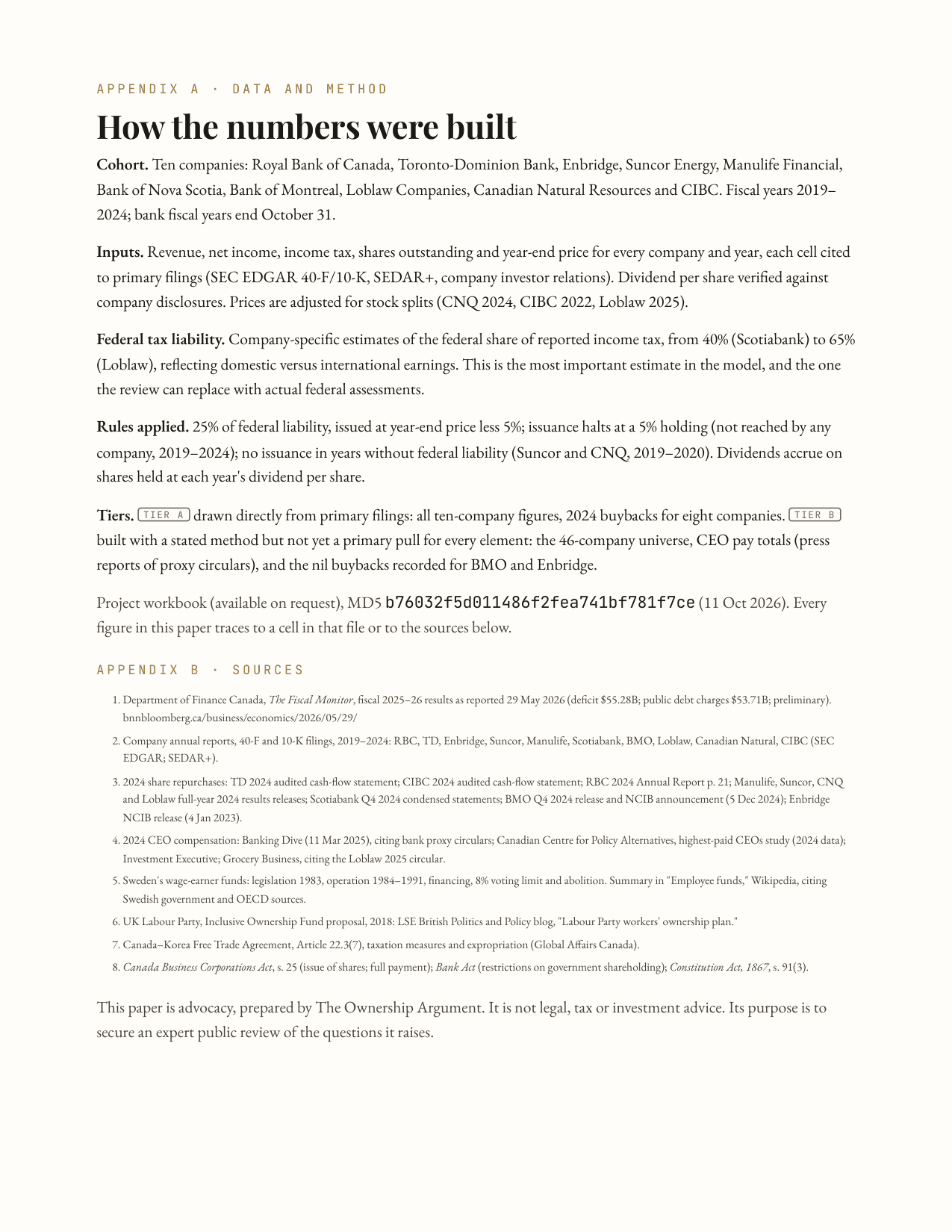
A P P E N D I X A · D A T A A N D M E T H O D
How the numbers were built
Cohort. Ten companies: Royal Bank of Canada, Toronto-Dominion Bank, Enbridge, Suncor Energy, Manulife Financial,
Bank of Nova Scotia, Bank of Montreal, Loblaw Companies, Canadian Natural Resources and CIBC. Fiscal years 2019–
2024; bank fiscal years end October 31.
Inputs. Revenue, net income, income tax, shares outstanding and year-end price for every company and year, each cell cited
to primary filings (SEC EDGAR 40-F/10-K, SEDAR+, company investor relations). Dividend per share verified against
company disclosures. Prices are adjusted for stock splits (CNQ 2024, CIBC 2022, Loblaw 2025).
Federal tax liability. Company-specific estimates of the federal share of reported income tax, from 40% (Scotiabank) to 65%
(Loblaw), reflecting domestic versus international earnings. This is the most important estimate in the model, and the one
the review can replace with actual federal assessments.
Rules applied. 25% of federal liability, issued at year-end price less 5%; issuance halts at a 5% holding (not reached by any
company, 2019–2024); no issuance in years without federal liability (Suncor and CNQ, 2019–2020). Dividends accrue on
shares held at each year's dividend per share.
Tiers. TIER A drawn directly from primary filings: all ten-company figures, 2024 buybacks for eight companies. TIER B
built with a stated method but not yet a primary pull for every element: the 46-company universe, CEO pay totals (press
reports of proxy circulars), and the nil buybacks recorded for BMO and Enbridge.
Project workbook (available on request), MD5 b76032f5d011486f2fea741bf781f7ce (11 Oct 2026). Every
figure in this paper traces to a cell in that file or to the sources below.
A P P E N D I X B · S O U R C E S
1. Department of Finance Canada, The Fiscal Monitor, fiscal 2025–26 results as reported 29 May 2026 (deficit $55.28B; public debt charges $53.71B; preliminary).
bnnbloomberg.ca/business/economics/2026/05/29/
2. Company annual reports, 40-F and 10-K filings, 2019–2024: RBC, TD, Enbridge, Suncor, Manulife, Scotiabank, BMO, Loblaw, Canadian Natural, CIBC (SEC
EDGAR; SEDAR+).
3. 2024 share repurchases: TD 2024 audited cash-flow statement; CIBC 2024 audited cash-flow statement; RBC 2024 Annual Report p. 21; Manulife, Suncor, CNQ
and Loblaw full-year 2024 results releases; Scotiabank Q4 2024 condensed statements; BMO Q4 2024 release and NCIB announcement (5 Dec 2024); Enbridge
NCIB release (4 Jan 2023).
4. 2024 CEO compensation: Banking Dive (11 Mar 2025), citing bank proxy circulars; Canadian Centre for Policy Alternatives, highest-paid CEOs study (2024 data);
Investment Executive; Grocery Business, citing the Loblaw 2025 circular.
5. Sweden's wage-earner funds: legislation 1983, operation 1984–1991, financing, 8% voting limit and abolition. Summary in "Employee funds," Wikipedia, citing
Swedish government and OECD sources.
6. UK Labour Party, Inclusive Ownership Fund proposal, 2018: LSE British Politics and Policy blog, "Labour Party workers' ownership plan."
7. Canada–Korea Free Trade Agreement, Article 22.3(7), taxation measures and expropriation (Global Affairs Canada).
8. Canada Business Corporations Act, s. 25 (issue of shares; full payment); Bank Act (restrictions on government shareholding); Constitution Act, 1867, s. 91(3).
This paper is advocacy, prepared by The Ownership Argument. It is not legal, tax or investment advice. Its purpose is to
secure an expert public review of the questions it raises.